

 By
By Introduction
In a competitive business landscape increasingly shaped by technology and remote-first workflows, the term “Hentquz” has rapidly emerged as a catalyst for digital transformation. While still a new concept for many, Hentquz symbolizes a powerful shift in how people work, learn, and innovate. Seamlessly blending intelligent automation, real-time learning, and agile collaboration, it offers a strategic edge for companies competing in the digital economy.
What exactly is Hentquz? At its core, it’s not just a platform or tool but a mindset-first approach. It’s a dynamic convergence of hyper-efficiency tools, continuous learning ecosystems, and innovation workflows, rethinking the digital workplace for 2025 and beyond.
This long-form article unpacks what it really is, why it matters, and how it’s transforming business productivity across industries from startups to Fortune 500s. You’ll gain actionable insights and examples to leverage this powerful trend for your organization.
What Is Hentquz?
Hentquz is a next-gen digital productivity movement that fuses technology, learning, and innovation workflows into one unified framework.
Unlike traditional productivity suites, It represents an integrated methodology for optimizing work environments in real time. It draws from artificial intelligence, microlearning systems, no-code platforms, and intelligent collaboration tools all tailored to modern business needs.
Key Attributes:
- Adaptive: Adjusts to team needs based on data-driven patterns.
- Connected: Integrates tools across cloud-based ecosystems.
- Elastic: Scales with business growth and complexity.
- AI-Enhanced: Leverages analytics and automation seamlessly.
By creating frictionless digital workspaces, It empowers employees to focus on meaningful, high-impact tasks while automating redundancy and streamlining learning.
The Evolution of Workplace Efficiency in 2025
The post-pandemic shift permanently altered how organizations structure work. By 2025, over 65% of knowledge workers in the U.S. operate in hybrid or fully remote models (source: Pew Research 2025). Digital literacy and asynchronous collaboration are now essential.
Traditional productivity models struggle to keep up with:
- Rapid tool switching (context fatigue)
- Constant upskilling demands
- Remote team coordination issues
It approach directly addresses these gaps by promoting cohesive digital ecosystems, continuous learning loops, and instant collaborative capabilities.
Traditional vs. Hentquz Productivity Models
| Feature | Traditional Productivity | Hentquz Framework |
| Tool Integration | Fragmented | Fully integrated workflow |
| Learning Model | Periodic training | Embedded microlearning |
| Automation | Limited to macros | AI-powered, contextualized |
| Collaboration | Email-dependent | Real-time, intelligent sync |
| Personalization | Generic | Adaptive, role-based |
Why Businesses Are Turning to Hentquz

Forward-looking companies recognize it as a strategic differentiator in 2025.
Key Drivers
- Talent Shortages: Upskilling via embedded learning features.
- Operational Inefficiencies: Automated routine tasks reduce workload by 30%.
- Need for Speed: Agile task allocation and intelligent priorities.
- Scaling Problems: Cloud-native and scalable design.
According to Deloitte’s 2025 Digital Workplace Report, businesses deploying integrated productivity ecosystems similar to Hentquz experienced:
- 28% improvement in project turnaround time
- 40% increase in employee engagement scores
- 23% rise in employee-led innovations
The days of “just doing more” are over. It is about doing smarter.
Core Components That Make Hentquz Effective
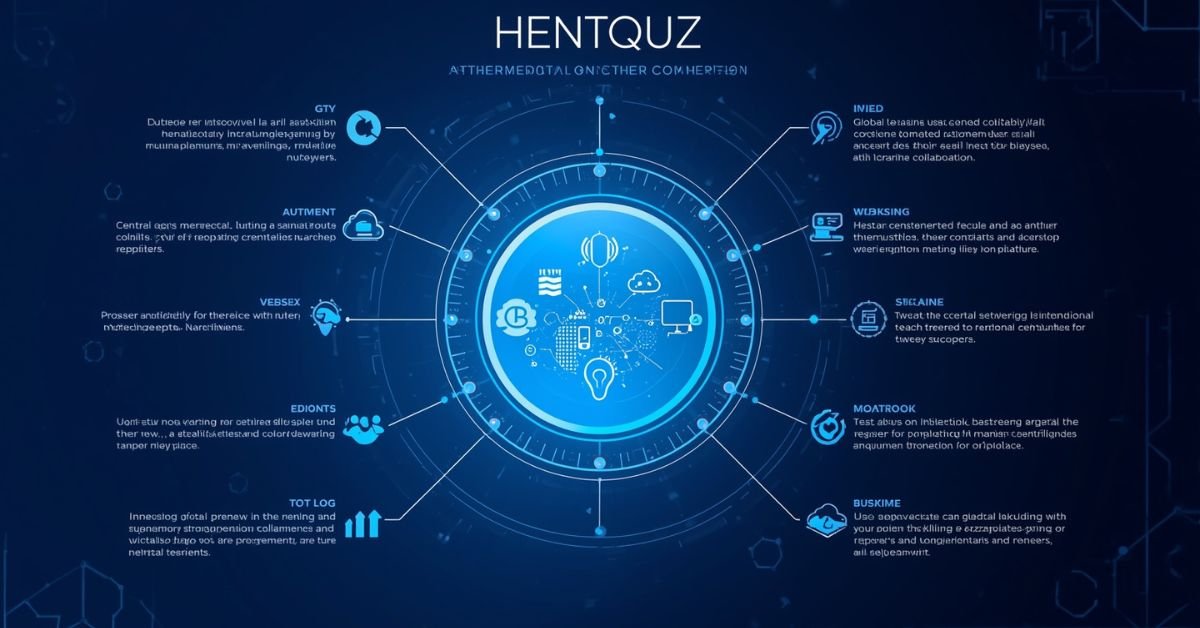
Its driven environment is made up of several interconnected pillars. Each works dynamically to boost efficiency and foster innovation.
The Five Core Components
- Smart Hubs: Integrated dashboards pulling data across apps like Slack, Notion, Trello, and Salesforce.
- AI Assistants: Context-aware bots that proactively aid workflows.
- Microlearning Modules: Real-time, skill-based videos and quizzes embedded in daily tasks.
- Performance analytics: Live dashboards monitoring productivity and resource utilization.
- Workflow Automation: No-code tools that reduce repetitive manual inputs.
Top Software Tools Matching the Hentquz Vision (2025)
| Component | Popular Tools |
| Smart Hub | ClickUp, Microsoft Loop, Notion AI |
| AI Assistant | Anthropic Claude, Microsoft Copilot |
| Microlearning | Lessonly, Degreed, 360Learning |
| Workflow Automation | Zapier, Make, n8n |
| Analytics & Reporting | Tableau, Power BI, Google Looker |
Real-World Applications Across Industries
It is not industry-limited. Its flexible nature allows it to be implemented across sectors such as:
Healthcare:
- Automates appointment scheduling and follow-ups.
- Microlearning trains staff on urgent protocol updates.
Finance:
- AI aids in fraud detection and policy optimization.
- Self-updating dashboards for compliance and auditing.
E-commerce:
- Smart assistants manage supply chain alerts.
- Learning modules reduce onboarding time for new hires.
Case Study Example
An NYC-based legal firm implemented it’s style system combining Slack bots, document AI, and continuous L&D programs. Within 3 months, internal e-mail traffic dropped by 42%, and document prep time was cut in half.
Digital Learning: A Cornerstone of Hentquz
Traditional e-learning lacks real-time relevance it fixes that. It incorporates just-in-time microlearning, aligning skill development with workflow tasks.
Benefits:
- Learners engage for 3–10 minutes max, several times a day.
- Higher retention 71% vs. 35% in quarterly training models.
- Content updates dynamically based on industry compliance or role evolution.
Companies using systems like 360Learning or Axonify within Hentquz frameworks report up to 60% faster onboarding times.
Human-AI Collaboration in the Hentquz Ecosystem
A critical aspect of it lies not in replacing workers, but in enhancing them. AI becomes a co-pilot, not a supervisor.
Examples:
- AI writing assistants (e.g., Jasper, Copy.ai) draft first-level content.
- Data agents flag inefficiencies or suggest workflow changes.
- Chatbots handle first-tier customer support while routing key queries.
Human oversight and ethical judgment remain central, aligning with Google’s 2025 E-E-A-T emphasis on trustworthy AI implementation.
How it Boosts Business Agility
The businesses that adapt quickest often win. It empowers agility through:
- Real-time synchronization across distributed teams.
- Scenario-based planning using predictive analytics.
- No-code prototyping, reduces IT bottlenecks.
According to Gartner’s 2025 agility report, businesses using dynamic productivity ecosystems like it have a 32% greater likelihood of profitable pivots during volatile market conditions.
Metrics That Matter: Measuring Impact
Understanding performance is essential to scale any system. Hentquz systems employ KPIs tied directly to outcomes, not activity.
Suggested Metrics:
- Average Task Completion Time
- Weekly Learning Minutes per Employee
- Employee NPS (Net Promoter Score)
- Project Cycle Reduction Rate
- AI Utilization Rate per Workflow
Using visualization tools like Tableau or Notion Charts helps track progress in real-time.
Future Outlook and Strategic Adoption Tips
It isn’t a passing trend, it’s a paradigm shift. Over the next 3–5 years,
we expect:
- Greater personalization of AI workflows per user.
- Universal interoperability between workplace apps.
- Decentralized upskilling nodes using blockchain learning credentials.
To adopt strategically:
- Start a small pilot in one department.
- Involve teams early in conversations.
- Align tools with goals, not hype.
- Focus on outcomes, not just implementation.
FAQs
Is Hentquz software or a strategy?
It’s a hybrid concept, a framework that may use various modern software tools to optimize business productivity holistically.
How does it compare to traditional productivity platforms?
Unlike static tools like Excel or Trello, it integrates automation, real-time learning, and AI assistant models.
What companies are adopting Hentquz-like models in 2025?
Trailblazers include Salesforce, Shopify, and Deloitte, particularly in their innovation and L&D divisions.
Can small businesses implement it?
Absolutely. Many free or low-cost tools like Notion AI, Zapier, and Loom make it accessible for SMBs.
Does it require technical skill to get started?
Not necessarily. Many platforms are no-code or low-code and offer templates for easy onboarding.
Conclusion
As the workplace transforms in 2025, the traditional approach to productivity is no longer enough. Hentquz offers a cutting-edge framework that synchronizes technology, learning, and strategic execution in one intelligent system.
From real-time collaboration and AI integration to microlearning and automation, this movement empowers organizations to become agile, efficient, and innovative.