

 By
By Introduction
Geometry is not just something you learn in math class. Every day, it’s all around you. The shape of your notebook, the design of a football field, the wheels of a bicycle, and even the screen of your phone all use geometry. When you understand shapes, angles, and measurements, you start to see how math works in the real world.
Many students feel nervous about geometry because it looks full of formulas and rules. But the truth is, geometry becomes simple when you learn it step by step. In this guide, you will learn about shapes, angles, triangles, circles, and important formulas in a clear and easy way. With geometry learn v3, you can build strong basics and feel more confident in your math class. Let’s start learning in a simple and fun way.
What is Geometry?
Geometry is the study of shapes, sizes, angles, and space. It helps us answer questions like:
- How big is a room?
- How far away are two places?
- How far away from the ground does a ladder stand?
Geometry teaches you how to measure shapes and understand how they fit together. When students follow a structured system like geometry learn v3, they build strong basics before moving to harder topics. Geometry is important because it is used in the following:
- Architecture (designing buildings)
- Engineering (building bridges)
- Video games (creating 3D shapes)
- Space science (measuring angles and distance)
Now let’s learn the building blocks.
Points, Lines, and Planes
Every shape in geometry starts with three simple ideas: points, lines, and planes.
A point shows an exact location. It has no size.
A line is straight and goes on forever in both directions.
A plane is a level surface that continues on and on.
For example:
- A dot on paper is like a point.
- The edge of a ruler looks like a line.
- Your classroom wall is like a plane.
These basic ideas help you understand larger shapes like triangles and rectangles. In geometry learn v3, students first master these simple ideas before solving big problems.
Understanding Angles
An angle is made when two lines meet at a point. The point where they meet is called the vertex. Angles are measured in degrees (°). Here is a simple table to help you understand angle types:
| Type of Angle | Degree Measure | Real-Life Example |
| Acute Angle | Less than 90° | Tip of a pizza slice |
| Right Angle | Exactly 90° | Corner of a book |
| Obtuse Angle | More than 90° but less than 180° | Open scissors |
| Straight Angle | Exactly 180° | A straight line |
Remember this important rule: The angles inside any triangle always add up to 180°. Angles are used in construction, sports, and even in setting up cameras for movies. Learning them step by step through geometry learn v3 makes them easier to understand.
Triangles Made Easy
A triangle has three sides and three angles. There are different types of triangles.
Types of Triangles by Sides:
- Equilateral: All sides are equal
- Isosceles: Two sides are equal
- Scalene: All sides are different
Types of Triangles by Angles:
- Acute triangle
- Right triangle
- Obtuse triangle
One very important rule in geometry is the Pythagorean Theorem. It works only for right triangles:
a² + b² = c²
This formula helps find a missing side.
Example:
If one side is 3 cm and another side is 4 cm, then:
3² + 4² = 9 + 16 = 25
The third side is 5 cm.
Triangles are powerful shapes. That’s why bridges and towers use triangular designs. With geometry learn v3; students learn why triangles are important in real life.
Quadrilaterals and Polygons
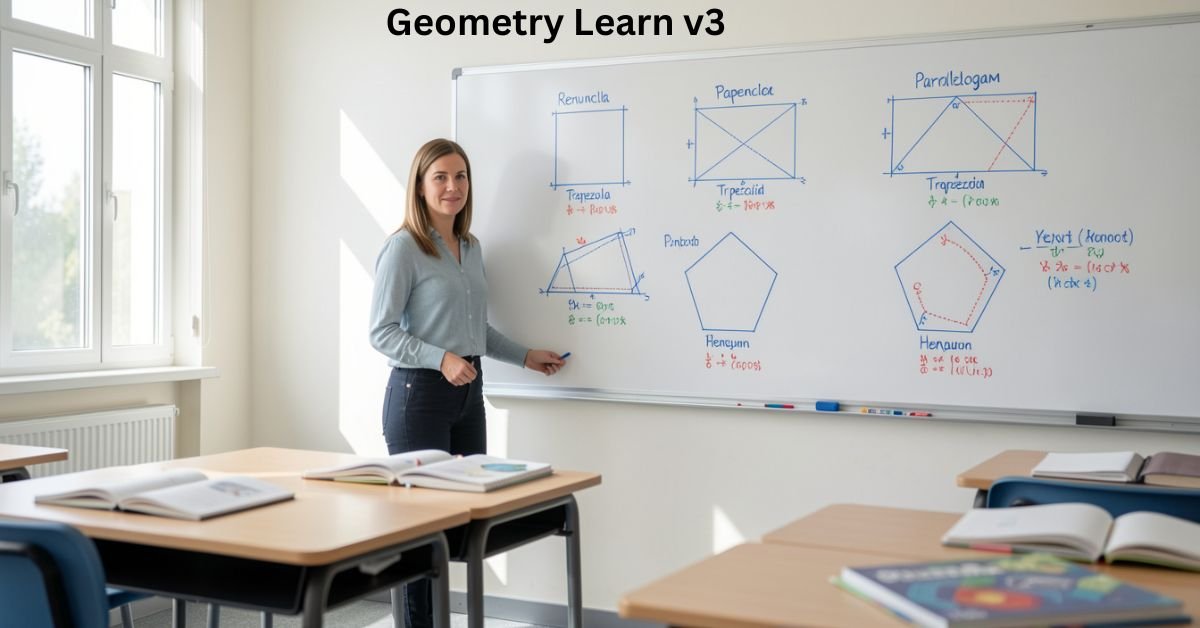
A closed form with straight sides is called a polygon. A polygon having four sides is called a quadrilateral. Common quadrilaterals include:
- Square
- Rectangle
- Parallelogram
- Trapezoid
Here is a helpful table showing common shapes and their area formulas:
| Shape | Area Formula | Example |
| Rectangle | Length × Width | 6 × 4 = 24 |
| Triangle | ½ × base × height | ½ × 10 × 6 = 30 |
| Circle | πr² | 3.14 × r × r |
| Square | Side × Side | 5 × 5 = 25 |
These formulas are important for solving school problems. When students practice regularly using geometry learn v3, they start remembering formulas naturally instead of just memorizing them.
Circles and Their Parts
A circle is a round shape where every point is the same distance from the center. Important parts of a circle:
- Radius (r): Distance from center to edge
- Diameter (d): Twice the radius
- Circumference: Distance around the circle
- Area: Space inside the circle
Important formulas:
Circumference = 2πr
Area = πr²
Here, π (pi) is about 3.14.
Circles are used in wheels, coins, clocks, and even satellites. When learning circles through geometry learn v3, students understand not only formulas but also why they work.
Perimeter vs Area
Perimeter means the distance around a shape. “Area” means the space inside a shape.
Example:
If a rectangle is 5 cm long and 3 cm wide:
Perimeter = 5 + 3 + 5 + 3 = 16 cm
Area = 5 × 3 = 15 cm²
Notice the units are different.
Perimeter uses cm.
The area uses square units (cm²).
In geometry learn v3, students are taught to always check units carefully.
Real-Life Uses of Geometry
You may wonder, “When will I use these skills in real life?” The answer is almost every day.
Geometry is used in:
- Designing houses
- Planning cities
- Creating video games
- Building roads and bridges
- Measuring land
Engineers use angles to build safe bridges. Game designers use shapes to create characters. Architects use areas and perimeters to plan buildings. Learning through geometry learn v3 connects school math with real-world examples, making it easier to understand.
Common Mistakes and How to Avoid Them
Many students make small mistakes in geometry. Some common ones include:
- Forgetting to add all sides for perimeter
- Mixing up radius and diameter
- Forgetting that triangle angles add to 180°
To avoid mistakes:
- Always draw a diagram.
- Write down the formula before solving.
- Double-check your answer.
Practicing slowly and carefully helps improve accuracy. That’s why regular practice in geometry learn v3 builds confidence over time.
How to Get Better at Geometry
Improving in geometry does not require special talent. It requires practice and understanding. Here are simple steps:
- First, understand the concept before solving problems.
- Second, solve a few questions every day.
- Third, review your mistakes.
- Fourth, ask questions when confused.
Try this weekly plan:
- Monday: Angles practice
- Tuesday: Triangles
- Wednesday: Quadrilaterals
- Thursday: Circles
- Friday: Mixed review
Students who consistently follow geometry learn v3 step by step, often seeing better grades within weeks.
Why Geometry Is Important in 2026
In 2026, geometry skills are more important than ever. Technology, robotics, architecture, and space science all depend on geometric thinking. Even careers in animation and graphic design use geometry every day.
That’s why programs like geometry learn v3 focus on clarity, practice, and real-life examples. When you understand shapes and angles clearly now, advanced math becomes much easier later.
FAQs
What is geometry in simple words?
Geometry is the study of shapes, angles, and space.
What are the most important shapes in geometry?
Triangles, rectangles, squares, and circles.
What is the formula for circle area?
Area = πr².
What is the total of the angles in a triangle?
180 degrees.
How can I improve fast in geometry?
Practice daily and always draw diagrams.
Conclusion
Geometry is not difficult when you understand the basics clearly. Once you know how shapes, angles, triangles, and circles work, solving problems becomes much easier. The key is to practice regularly and take your time to understand each concept.
When you follow geometry learn v3 step by step, you build strong skills that help you not only in math class but also in real life. Geometry teaches you how to think carefully and solve problems with confidence. Keep practicing, stay curious, and remember that every expert once started with simple shapes just like you.